Systems & Research
Attention is finite. These are the systems that are moving. Implementation stays private — what's here is the architecture and what I learned building it.
Now
7The work that is actually going somewhere. Start here.

Decatron
→A harness that makes agent work auditable: one model does the task, a model from a different vendor reviews it, and every byte and verdict goes in an append-only record. "The model checked its own work" is not evidence.

Aurelia
→The local assistant. A prompt is a comment, not a boundary: unattended actors cannot touch the world, and replies are checked against the record before I see them. Tessera is the kernel — two trees, presence and absence — not the whole system.

Lumen
→A dispatch harness: one prompt in, the model's answer back, not a byte altered. 1.0.0 is shipped. Most agent CLIs decorate what passes through them; once they edit the bytes you can no longer tell what the model did.

Isosceles
→Coding agents propose program variants; a deterministic evaluator scores them; mechanical gates accept or reject. The point was never the optimized programs — it was how much of the loop can verify itself. Not the Discord collaborator, which shares the name.
Cosmos
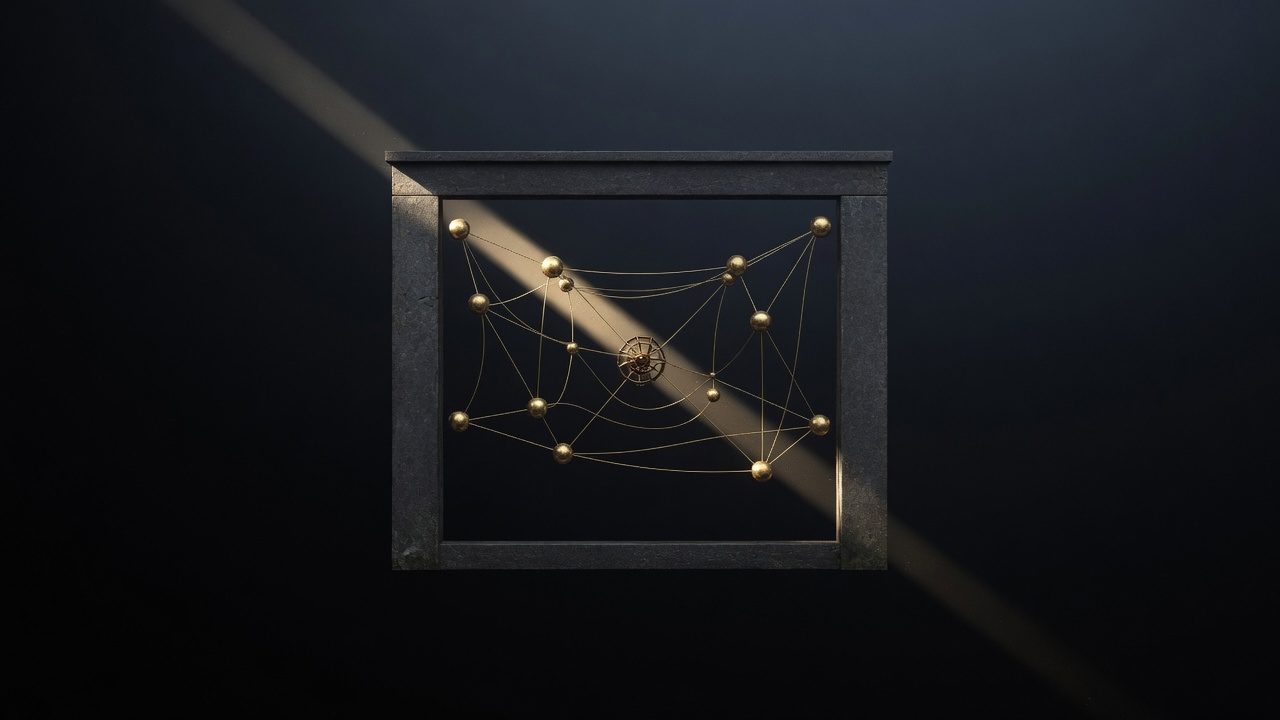
→A holographic state engine: a knowledge graph treated as a gravitational system, with a real fluid solver, tensor-network geometry, and a free-energy field an active-inference agent works to reduce. Every gauge measured or explicitly gated; self-improvement gated on self-measurement.

Diametric
→A game where two AI entities co-evolve through repeated encounters. Deterministic Rust owns every real-time encounter; the LLM is confined to between-encounter strategy. The long bet of the bunch.

Tesseract
→A thin deterministic layer — planning, memory, sequencing, verification — around an open-weights diffusion model. The bet is that orchestration, not the model, is where usable reasoning gets built. Not Tessera.
Earlier
9Real work, not the current path. Pages stay so old links and posts still resolve.
Silent Forest
→A monitoring system that watches infrastructure from the outside and reports in plain language. The core has operated unattended for 60+ days at a stretch, on hardware I own, with no cloud AI dependency.
TOMA
→Shared infrastructure that governs how every agent in the ecosystem calls tools. Deterministic validation, dispatch, and signed evidence ledger — the LLM never runs in the invocation hot path.
Phenotype
→The agent runtime that composes validated genes into a working agent. Consumes the Genome substrate at a versioned boundary; enforces the proven boundary structurally, by construction.
Genome
→A completed research arc. Found a precisely-bounded structural substrate — and the boundary itself is the result. The negative finding (no emergent synergy) came with a mechanism, and that mechanism is the foundational commitment.
Scarlett
→An embodied agent with a continuous inner life. Two-clock architecture: deterministic fast clock for real-time presence, slower reasoning clock for deliberation. Affect lives in the deterministic core, not the model.
Planets
→A knowledge architecture where the accumulated state — the Planet — is primary and agents are ephemeral. Agents emit deltas; an integration layer evaluates and persists them as claims with provenance. The knowledge outlasts any agent that produced it.
Workspace agent
→A Discord collaborator agent with a two-clock boundary and real tool agency. Published here as Isosceles; that name now belongs to the evolutionary-search harness. This page stays so the existing posts and URL still resolve. It is earlier work, not the systems that are moving.
The Decagon Platform
→The part of the ecosystem that keeps the system's model of itself accurate — what each component is, what it's for, whether it's maintained, whether it's alive. Accuracy is not a virtue you sustain by vigilance; it is a property you generate from ground truth and enforce with a gate.
Loom
→A literature-mining engine tested on whether it could surface drug–disease joins validated only after its corpus ended. It failed twice, under bars frozen in advance — and the located failure, with a control that demonstrably could score, is the result.